
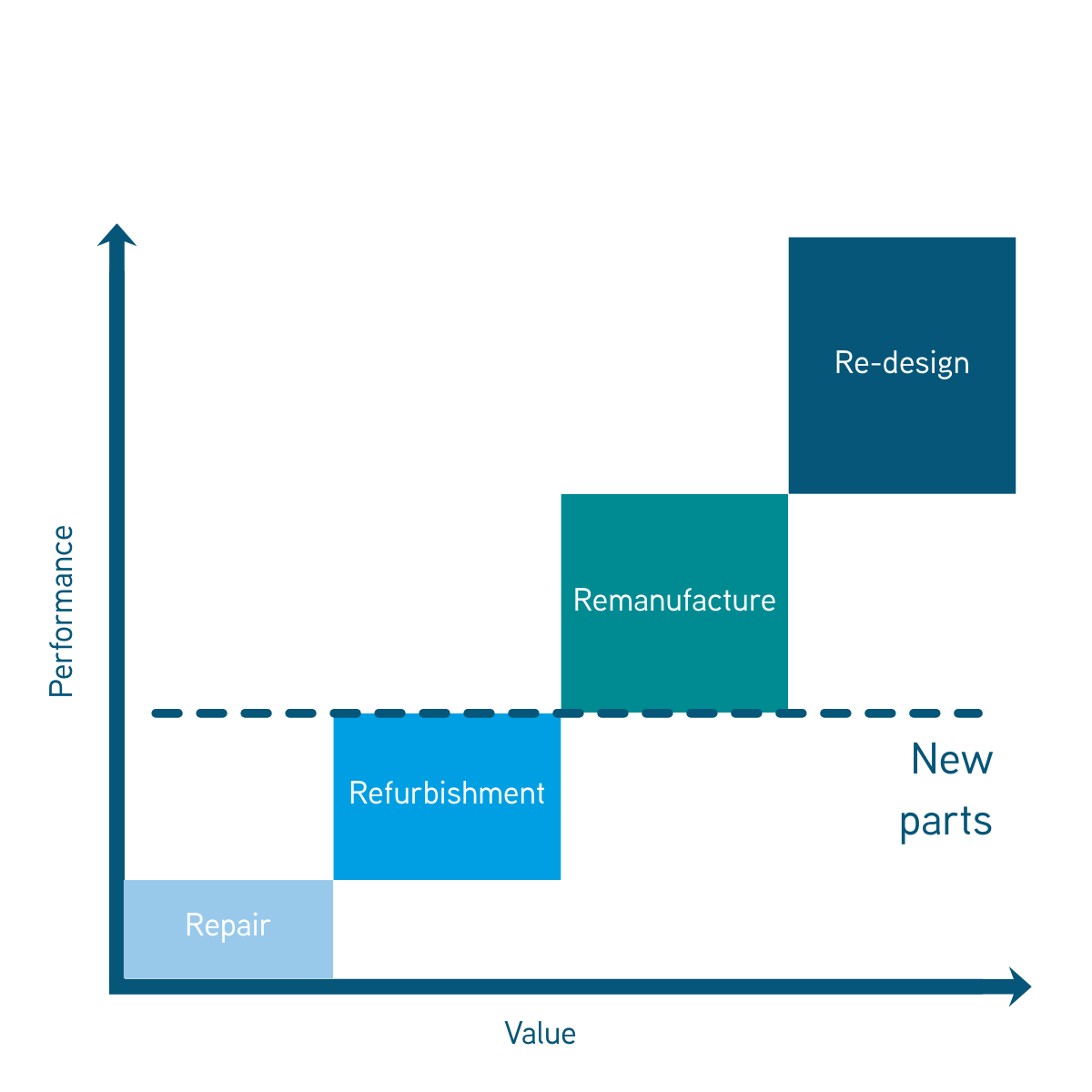
Refurbishment typically restores a component to usable condition. Remanufacture is a more controlled, engineering-led rebuild designed to restore performance to a defined specification, often including machining and replacement of critical wear elements.
What is remanufacture?
The wind industry is following the same proven path as Aerospace and Oil and Gas. For decades, those sectors have shown that advanced engineering and disciplined processes can deliver high performance, high integrity remanufacturing at scale.
But not all reuse is equal.
There is a clear difference between basic repair and true remanufacture. Repair addresses a visible failure. Remanufacture restores the component to an equivalent or improved standard compared to new.
Our approach is lifecycle focused. We do not simply replace what has failed. We assess the full condition of the asset and replace or rework components that are likely to fail within the next operational cycle. The result is a fully restored component with extended service life and reduced risk.
In many cases, remanufacture includes performance upgrades. Higher specification materials, improved tolerances and enhanced assemblies can deliver a component that outperforms the original.
Where repeat failure mechanisms are known, redesign takes this further. We engineer out the root cause, improve durability and reduce in service failure rates.
This is not short term repair. It is engineered life extension, aligned to net zero and built for long term performance.
Engineered rebuilds to a defined standard, with full traceability.
Our remanufacture process

Assessment and inspection
We review the failure mode, operating conditions and critical tolerances, then complete strip-down and dimensional checks.

Engineering review and scope
We define the remanufacture route, including required machining, replacement parts and any upgrades or improvements via our Technical Services team.

Restore and rebuild
Critical interfaces are restored to specification, with wear components replaced where required.

Quality control and documentation
Components are reassembled, checked against agreed requirements, then released with supporting documentation and traceability.
Benefits of choosing remanufactured over new
Lower cost than fit new without compromising performance
Shorter lead times by keeping valueable components in circualation
Reduced waste and carbon by avoiding unnecessary new manufacturers
Better lifecycle support for ageing fleets where obsolescence is a risk
A practical route to sustainability that supports operational targets
FAQs
We can help
Speak to our team
If you’re managing ageing assets, repeated failures, long lead times, or parts obsolescence, our remanufacture service can help you keep turbines operating while reducing cost and waste.